

Health Library
Lung metastases
Metastases to the lung; Metastatic cancer to the lung; Lung cancer - metastases; Lung mets
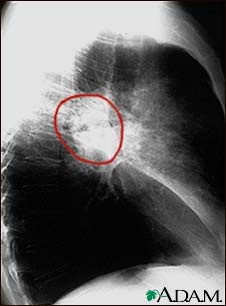
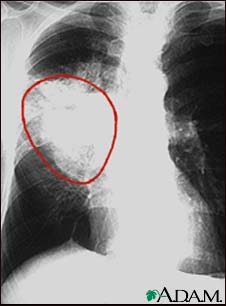
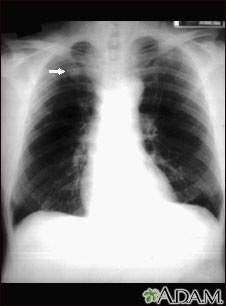
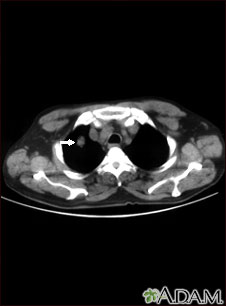
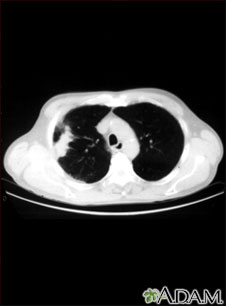
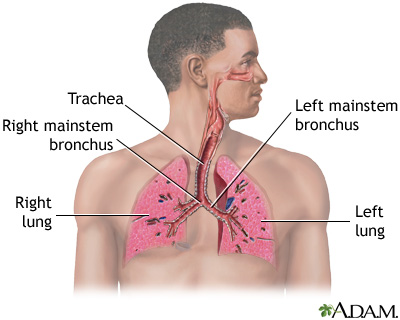
Lung metastases are cancerous tumors that start somewhere else in the body and spread to the lungs.
Images
I Would Like to Learn About:
Causes
Metastatic tumors in the lungs are cancers that developed at other places in the body (or other parts of the lungs). They then spread through the bloodstream or lymphatic system to the lungs. It is different than lung cancer that starts in the lungs.
Nearly any cancer can spread to the lungs. Common cancers that do this include:
- Bladder cancer
- Breast cancer
- Lung cancer
- Colorectal cancer
- Kidney cancer
- Melanoma
- Ovarian cancer
- Pancreatic cancer
- Sarcoma
- Testicular cancer
- Thyroid cancer
Symptoms
Symptoms may include any of the following:
Exams and Tests
Your health care provider will examine you and ask about your medical history and symptoms. Tests that may be done include:
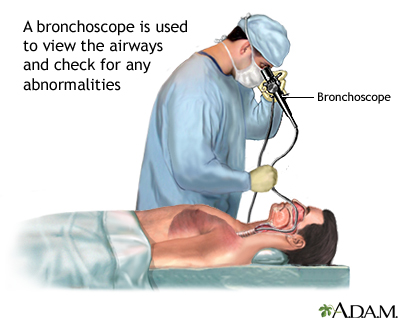
- Bronchoscopy to view the airways and take tissue samples, if possible
- Chest CT scan
- Chest x-ray
- Cytologic studies of pleural fluid or sputum
- Lung needle biopsy
- PET scan
- Surgery to take a sample of tissue from the lungs (surgical lung biopsy)
Treatment
Chemotherapy is often used to treat metastatic cancer to the lung. Surgery to remove the tumors may be done when any of the following occurs:
- The cancer has spread to only limited areas of the lung
- The lung tumors can be completely removed with surgery
However, the main tumor must be curable, and the person must be strong enough to go through the surgery and recovery.
Other treatments include:
- Radiation therapy
- Immunotherapy
- Targeted systemic therapy
- The placement of stents inside the airways
- Laser therapy
- Using local heat probes to destroy the cancer
- Using very cold temperature probes to destroy the cancer
Support Groups
You can ease the stress of illness by joining a support group where members share common experiences and problems.
Outlook (Prognosis)
A cure is unlikely in most cases of cancers that have spread to the lungs. But the outlook depends on the main cancer. In some cases, a person can live more than 5 years with metastatic cancer to the lungs.
Possible Complications
Complications of metastatic tumors in the lungs may include:
- Fluid between the lung and chest wall (pleural effusion), which can cause shortness of breath or pain when taking a deep breath
- Further spread of the cancer
When to Contact a Medical Professional
Contact your provider if you have a history of cancer and you develop:
- Coughing up blood
- Persistent cough
- Shortness of breath
- Unexplained weight loss
Prevention
Not all cancers can be prevented. However, the chance of getting many cancers can be reduced by:
- Eating healthy foods
- Exercising regularly
- Limiting alcohol consumption
- Not smoking
Related Information
CancerBreast cancer
Colorectal cancer
Prostate cancer
Bladder cancer
Neuroblastoma
Wilms tumor
Chemotherapy
Radiation therapy
Lung cancer
References
Arenberg DA, Reddy RM. Metastatic malignant tumors. In: Broaddus VC, Ernst JD, King TE, et al, eds. Murray and Nadel's Textbook of Respiratory Medicine. 7th ed. Philadelphia, PA: Elsevier; 2022:chap 79.
Hayman J, Naidoo J, Ettinger DS. Lung metastases. In: Niederhuber JE, Armitage JO, Kastan MB, Doroshow JH, Tepper JE, eds. Abeloff's Clinical Oncology. 6th ed. Philadelphia, PA: Elsevier; 2020:chap 57.
National Cancer Institute website. Metastatic cancer: When cancer spreads. www.cancer.gov/types/metastatic-cancer. Updated January 17, 2025. Accessed May 31, 2026.
Rossetti NE, Tohmasi S, Onaitis MW, Kozower BD. Lung, chest wall, pleura, and mediastinum. In: Tyler DS, Hayes-Dixon A, Hines OJ, et al, eds. Sabiston Textbook of Surgery: The Biological Basis of Modern Surgical Practice. 22nd ed. Philadelphia, PA: Elsevier; 2026:chap 110.
BACK TO TOPReview Date: 5/1/2026
Reviewed By: Warren Brenner, MD, Oncologist, Lynn Cancer Institute, Boca Raton, FL. Review provided by VeriMed Healthcare Network. Also reviewed by David C. Dugdale, MD, Medical Director, Brenda Conaway, Editorial Director, and the A.D.A.M. Editorial team.
 | A.D.A.M., Inc. is accredited by URAC, for Health Content Provider (www.urac.org). URAC's accreditation program is an independent audit to verify that A.D.A.M. follows rigorous standards of quality and accountability. A.D.A.M. is among the first to achieve this important distinction for online health information and services. Learn more about A.D.A.M.'s editorial policy, editorial process and privacy policy. A.D.A.M. is also a founding member of Hi-Ethics. This site complies with the HONcode standard for trustworthy health information: verify here. |
The information provided herein should not be used during any medical emergency or for the diagnosis or treatment of any medical condition. A licensed medical professional should be consulted for diagnosis and treatment of any and all medical conditions. Links to other sites are provided for information only -- they do not constitute endorsements of those other sites. No warranty of any kind, either expressed or implied, is made as to the accuracy, reliability, timeliness, or correctness of any translations made by a third-party service of the information provided herein into any other language.
© 1997-
2026 A.D.A.M., a business unit of Ebix, Inc. Any duplication or distribution of the information contained herein is strictly prohibited.
All content on this site including text, images, graphics, audio, video, data, metadata, and compilations is protected by copyright and other intellectual property laws. You may view the content for personal, noncommercial use. Any other use requires prior written consent from Ebix. You may not copy, reproduce, distribute, transmit, display, publish, reverse-engineer, adapt, modify, store beyond ordinary browser caching, index, mine, scrape, or create derivative works from this content. You may not use automated tools to access or extract content, including to create embeddings, vectors, datasets, or indexes for retrieval systems. Use of any content for training, fine-tuning, calibrating, testing, evaluating, or improving AI systems of any kind is prohibited without express written consent. This includes large language models, machine learning models, neural networks, generative systems, retrieval-augmented systems, and any software that ingests content to produce outputs. Any unauthorized use of the content including AI-related use is a violation of our rights and may result in legal action, damages, and statutory penalties to the fullest extent permitted by law. Ebix reserves the right to enforce its rights through legal, technological, and contractual measures.
